

Designing a proper ventilation system for clean room equipment is a critical task that directly impacts the performance, safety, and efficiency of the clean room environment. As a supplier of clean room equipment, I have witnessed firsthand the importance of a well - designed ventilation system. In this blog, I will share some key considerations and steps to design an appropriate ventilation system for clean room equipment.
Understanding the Clean Room Requirements
Before diving into the ventilation system design, it is essential to understand the specific requirements of the clean room. Different clean rooms have different cleanliness levels, which are classified according to international standards such as ISO 14644. For example, a semiconductor manufacturing clean room may require a much higher level of cleanliness (ISO Class 1 - 4) compared to a general laboratory clean room (ISO Class 5 - 8).
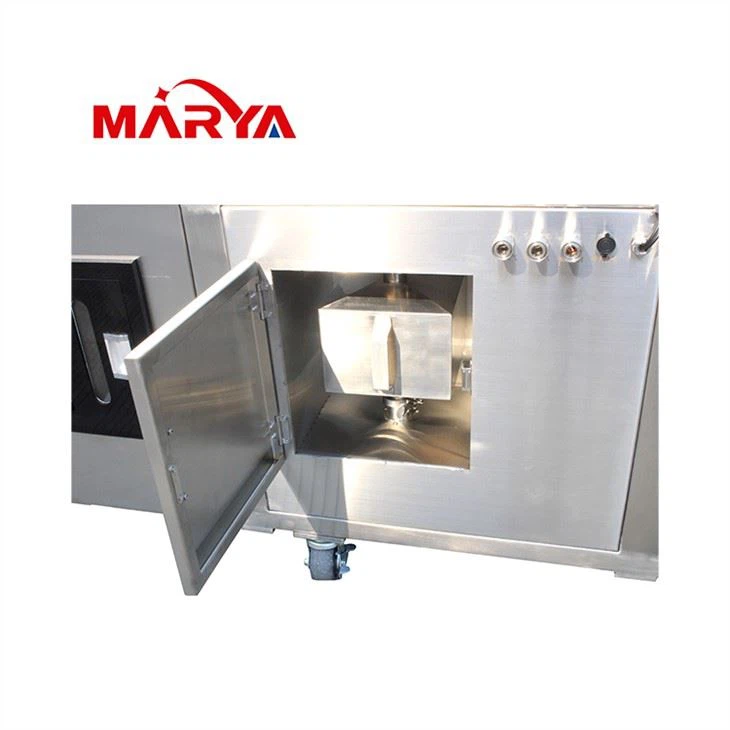

The type of clean room equipment also plays a crucial role. Equipment like Sampling Booth, Biosafety Cabinet, and Clean Room Pass Box have different ventilation needs. Sampling booths need to ensure that the sampled materials are not contaminated by external air, while biosafety cabinets must prevent the release of harmful biological agents into the environment.
Calculating Airflow Requirements
One of the primary steps in designing a ventilation system is to calculate the required airflow. This calculation is based on several factors, including the size of the clean room, the number and type of equipment, and the desired air change rate.
The air change rate is defined as the number of times the entire volume of air in the clean room is replaced within an hour. For clean rooms with higher cleanliness requirements, a higher air change rate is typically needed. For instance, an ISO Class 5 clean room may require an air change rate of 20 - 60 times per hour, while an ISO Class 8 clean room may only need 10 - 20 times per hour.
The formula for calculating the required airflow (Q) is:
[Q = V\times n]
where (V) is the volume of the clean room ((m^3)) and (n) is the air change rate (per hour).
For example, if a clean room has a volume of (100 m^3) and an air change rate of 30 times per hour, the required airflow is (Q = 100\times30=3000 m^3/h).
Selecting the Right Ventilation Equipment
Once the airflow requirements are determined, the next step is to select the appropriate ventilation equipment. The main components of a clean room ventilation system include air handling units (AHUs), fans, filters, and ductwork.
- Air Handling Units (AHUs): AHUs are responsible for conditioning the air, including heating, cooling, humidifying, and dehumidifying. They also house the filters that remove particles and contaminants from the air. When selecting an AHU, consider its capacity, energy efficiency, and the type of filters it can accommodate.
- Fans: Fans are used to move the air through the ventilation system. There are different types of fans, such as centrifugal fans and axial fans. Centrifugal fans are suitable for systems with high resistance, while axial fans are more efficient for low - resistance systems.
- Filters: Filters are the heart of the clean room ventilation system. High - efficiency particulate air (HEPA) filters and ultra - low penetration air (ULPA) filters are commonly used in clean rooms. HEPA filters can remove at least 99.97% of particles with a size of 0.3 micrometers, while ULPA filters can remove at least 99.999% of particles with a size of 0.12 micrometers. The choice of filter depends on the cleanliness level of the clean room.
- Ductwork: Ductwork is used to distribute the conditioned air throughout the clean room. It should be designed to minimize air leakage and pressure drop. Smooth - walled ducts are preferred to reduce the accumulation of particles.
Designing the Air Distribution System
The air distribution system is responsible for delivering the conditioned air to the clean room in a uniform and efficient manner. There are two main types of air distribution systems: laminar flow and non - laminar flow.
- Laminar Flow: Laminar flow systems provide a unidirectional flow of air, either vertically or horizontally. Vertical laminar flow is commonly used in clean rooms where the equipment is placed on the floor, while horizontal laminar flow is suitable for clean rooms with equipment arranged along the walls. Laminar flow systems are ideal for clean rooms with high - precision manufacturing processes or sensitive biological experiments.
- Non - Laminar Flow: Non - laminar flow systems, also known as turbulent flow systems, provide a more random distribution of air. They are less expensive to install and operate compared to laminar flow systems and are suitable for clean rooms with lower cleanliness requirements.
Controlling Pressure and Temperature
Maintaining the correct pressure and temperature in the clean room is essential for its proper operation. Positive pressure is typically maintained in clean rooms to prevent the ingress of external contaminants. The pressure difference between the clean room and the adjacent areas should be carefully controlled. For example, in a pharmaceutical clean room, a positive pressure of 5 - 10 Pa may be maintained relative to the corridors.
Temperature control is also crucial, especially for clean rooms where the equipment or processes are sensitive to temperature changes. The temperature in a clean room is usually maintained within a narrow range, such as (20 - 24^{\circ}C). The ventilation system should be designed to work in conjunction with the heating and cooling systems to achieve the desired temperature.
Monitoring and Maintenance
A well - designed ventilation system requires regular monitoring and maintenance to ensure its long - term performance. Monitoring parameters include airflow, pressure, temperature, humidity, and particle counts. Continuous monitoring can detect any abnormalities in the system and allow for timely corrective actions.
Maintenance tasks include replacing filters, cleaning the ductwork, and inspecting the fans and other equipment. Filters should be replaced according to the manufacturer's recommendations or when the pressure drop across the filter reaches a certain level.
Conclusion
Designing a proper ventilation system for clean room equipment is a complex but essential task. By understanding the clean room requirements, calculating the airflow, selecting the right equipment, designing the air distribution system, controlling pressure and temperature, and implementing regular monitoring and maintenance, a high - performance ventilation system can be achieved.
If you are in the market for clean room equipment and need assistance with ventilation system design, we are here to help. Our team of experts has extensive experience in providing customized solutions for clean rooms of all sizes and applications. Contact us to start a procurement discussion and let us work together to create the ideal clean room environment for your needs.
References
- ISO 14644 - 1:2015, Cleanrooms and associated controlled environments - Part 1: Classification of air cleanliness.
- ASHRAE Handbook - HVAC Systems and Equipment, American Society of Heating, Refrigerating and Air - Conditioning Engineers.
- Clean Room Design and Operation: A Practical Guide, John Wiley & Sons.