

Determining the appropriate number of Clean Room Fan Filter Units (FFUs) for a specific clean room is a critical step in ensuring its optimal performance and adherence to the required cleanliness standards. As a Clean Room FFU supplier, I understand the complexities involved in this calculation and the importance of getting it right. In this blog post, I will guide you through the process of calculating the number of FFUs needed for your clean room, taking into account various factors that influence the decision.
Understanding the Basics of Clean Room FFUs
Before diving into the calculation, it's essential to have a clear understanding of what Clean Room FFUs are and how they function. FFUs are self - contained units that consist of a fan and a high - efficiency particulate air (HEPA) or ultra - low penetration air (ULPA) filter. They are designed to provide a continuous supply of filtered air into the clean room, removing contaminants such as dust, bacteria, and other particles.
The main purpose of FFUs in a clean room is to maintain a specific level of air cleanliness, which is classified according to international standards such as ISO 14644. These standards define the maximum allowable number of particles of a certain size per cubic meter of air in a clean room environment.
Factors Affecting the Number of FFUs
Several factors need to be considered when calculating the number of FFUs required for a clean room. These include:
Clean Room Size
The size of the clean room is one of the most significant factors. Larger clean rooms will generally require more FFUs to ensure adequate air circulation and filtration. The volume of the clean room, which is calculated by multiplying the length, width, and height of the room, provides a starting point for the calculation.
Cleanliness Class
The desired cleanliness class of the clean room is another crucial factor. Higher cleanliness classes, such as ISO Class 3 or 4, require a greater number of FFUs to maintain the low particle counts specified by the standards. Lower cleanliness classes, like ISO Class 8 or 9, may need fewer FFUs.
Air Change Rate
The air change rate refers to the number of times the entire volume of air in the clean room is replaced per hour. Different clean room applications have different recommended air change rates. For example, a clean room used for semiconductor manufacturing may require a higher air change rate compared to a clean room for general laboratory use. A higher air change rate will necessitate more FFUs to achieve the desired air turnover.
Layout and Obstructions
The layout of the clean room and the presence of any obstructions can also affect the number of FFUs. Obstructions such as equipment, partitions, or storage shelves can disrupt the air flow, requiring additional FFUs to ensure uniform air distribution throughout the room.
Calculating the Number of FFUs
The following steps can be used to calculate the number of FFUs needed for a specific clean room:
Step 1: Determine the Clean Room Volume
As mentioned earlier, calculate the volume of the clean room by multiplying its length (L), width (W), and height (H). The formula is (V = L\times W\times H). For example, if a clean room has a length of 10 meters, a width of 8 meters, and a height of 3 meters, the volume (V=10\times8\times3 = 240) cubic meters.
Step 2: Decide on the Air Change Rate
Refer to industry standards or the specific requirements of your clean room application to determine the appropriate air change rate. Let's assume that for our clean room, the recommended air change rate is 20 air changes per hour.

Step 3: Calculate the Required Airflow
Multiply the clean room volume by the air change rate to obtain the required airflow in cubic meters per hour ((m^{3}/h)). Using the example above, the required airflow (Q = V\times) air change rate (=240\times20 = 4800m^{3}/h).
Step 4: Determine the Airflow Capacity of a Single FFU
The airflow capacity of an FFU is usually specified by the manufacturer. Let's assume that each FFU we are considering has an airflow capacity of (1200m^{3}/h).
Step 5: Calculate the Number of FFUs
Divide the required airflow by the airflow capacity of a single FFU to get the number of FFUs needed. In our example, the number of FFUs (N=\frac{Q}{airflow\ capacity\ of\ a\ single\ FFU}=\frac{4800}{1200}=4).
However, this is a simplified calculation. In real - world scenarios, other factors such as air leakage, the efficiency of the FFUs, and the presence of heat sources need to be considered. It is also advisable to add a safety margin of around 10 - 20% to account for any unforeseen factors.
Additional Considerations
In addition to the calculation, there are other aspects to keep in mind when planning for the installation of FFUs in a clean room.
Air Distribution
Proper air distribution is essential for maintaining uniform cleanliness throughout the clean room. The layout of the FFUs should be carefully designed to ensure that air is evenly distributed. This may involve using a grid pattern or other arrangements to prevent dead spots where particles can accumulate.
Filter Maintenance
Regular filter maintenance is crucial for the long - term performance of the FFUs. HEPA and ULPA filters need to be replaced periodically to maintain their efficiency. As a supplier, we can provide guidance on filter replacement schedules and offer high - quality replacement filters.
Complementary Clean Room Equipment
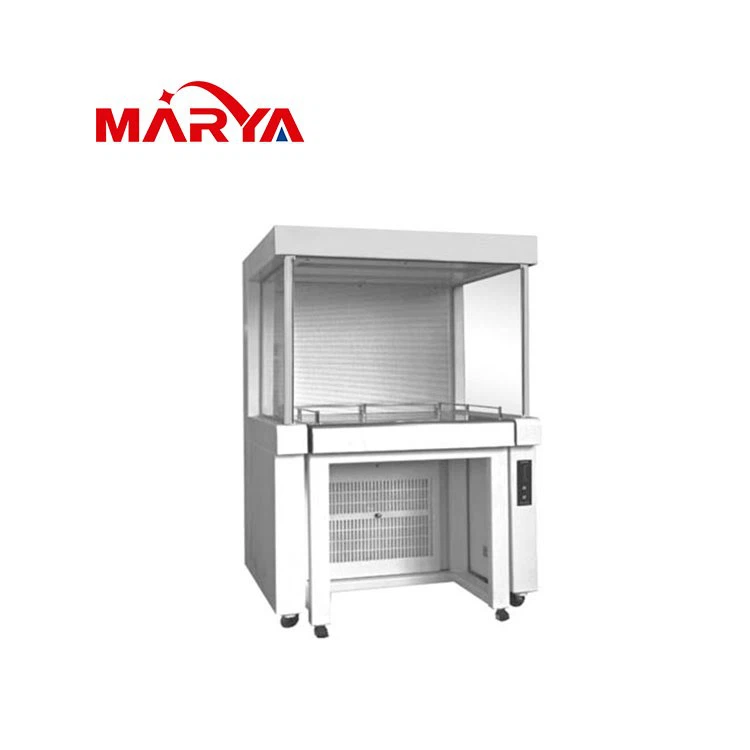
To enhance the overall performance of the clean room, it may be necessary to consider complementary equipment such as Clean Bench, Online Dust Particle Monitoring System, and Cleanroom Mist Shower. These equipment can work in conjunction with the FFUs to provide a more comprehensive clean room solution.
Conclusion
Calculating the number of Clean Room FFUs needed for a specific clean room is a complex but essential process. By considering factors such as clean room size, cleanliness class, air change rate, and layout, you can determine the appropriate number of FFUs to ensure the clean room meets the required standards. As a Clean Room FFU supplier, we have the expertise and experience to assist you in this process. Whether you are building a new clean room or upgrading an existing one, we can provide you with high - quality FFUs and comprehensive support.
If you are interested in learning more about our Clean Room FFUs or need help with the calculation for your clean room, please feel free to contact us. We look forward to discussing your requirements and providing you with a customized solution.
References
- ISO 14644 - 1: Cleanrooms and associated controlled environments — Part 1: Classification of air cleanliness.
- Clean Room Design and Operation Manuals from industry - leading organizations.